Air cooling is hitting its limits. Unlock the full potential with immersion: maximum density, minimal energy waste.
Immersion cooling is not only a different way to cool IT equipment—it represents a shift in how compute can be deployed, operated, and scaled. As workloads grow more demanding, energy efficiency expectations rise, and hardware power envelopes increase, many organisations are finding that traditional air-based cooling models are approaching practical limits.
By removing heat directly at the source, immersion cooling creates a stable and predictable thermal environment while reducing reliance on complex mechanical infrastructure. This enables benefits across a wide range of environments—from large-scale datacentres to on-premise systems, edge deployments, and service-provider platforms.
The Core Benefits of Immersion Cooling
Across environments, immersion coolingdelivers a shared set of foundational advantages:
- Direct liquid heat transfer, enabling high thermal efficiency
- High and predictable compute density without airflow constraints
- Lower energy consumption, including elimination of server fan power
- Stable thermal behaviour, reducing hotspots and thermal cycling
- Simplified operations by removing airflow management
- Reduced water dependency, compared to evaporative cooling approaches
- Flexibility for future hardware generations and mixed architectures
How these benefits are prioritised—and whyimmersion cooling is adopted—varies by audience and use case.
Why Immersion Cooling in Datacentres
Owned Datacentres and Colocation Facilities
In traditional datacentres, cooling infrastructure often defines the ceiling for growth. Airflow management,chiller capacity, water usage, and mechanical redundancy constrain density,efficiency, and expansion.
Immersion cooling changes these constraints at a system level.
Key benefits for datacentres include:
More usable capacity within existing facilities
By removing airflow constraints, immersion cooling allows significantly higher IT load to be deployed within the same footprint—particularly valuable in brownfield sites and space-constrained buildings.
Improved and more stable energy efficiency
Direct liquid cooling reduces cooling overhead and server fan energy, helping datacentres achieve lower and more consistent PUE across seasons and climates.
Reduced water consumption
Immersion cooling enables heat rejection via dry coolers or warm-water loops, reducing or eliminating dependence on evaporative cooling—an increasingly important consideration in water-constrained regions.
Operational predictability
Immersion creates a uniform thermal environment. Fluid temperatures, flows, and ΔT values tend to remain within narrow bands, simplifying monitoring and reducing operational variability.
Colocation differentiation
For colocation providers, immersion cooling enables support for higher-density customer deployments, accommodation of diverse and fast-changing hardware profiles, and new service offerings without redesigning entire facilities.
Future readiness
As processor power increases and hardware diversity expands, immersion cooling provides a platform that adapts without repeated mechanical redesign.
Why Immersion Cooling Beyond the Datacentre
On-Premise Compute, Edge, and Non-Traditional Environments
Not all compute is deployed in purpose-built datacentres. Increasingly, organisations need to place compute closer to applications, users, and data sources—in environments where traditional datacentre infrastructure is impractical, inefficient, or unavailable.
In these scenarios, the primary value of immersion cooling is not always energy optimisation. Instead, it is the ability to deploy high-density, high-performance compute reliably in non-optimal environments.
Immersion Cooling as a “Datacentre-in-a-Box”
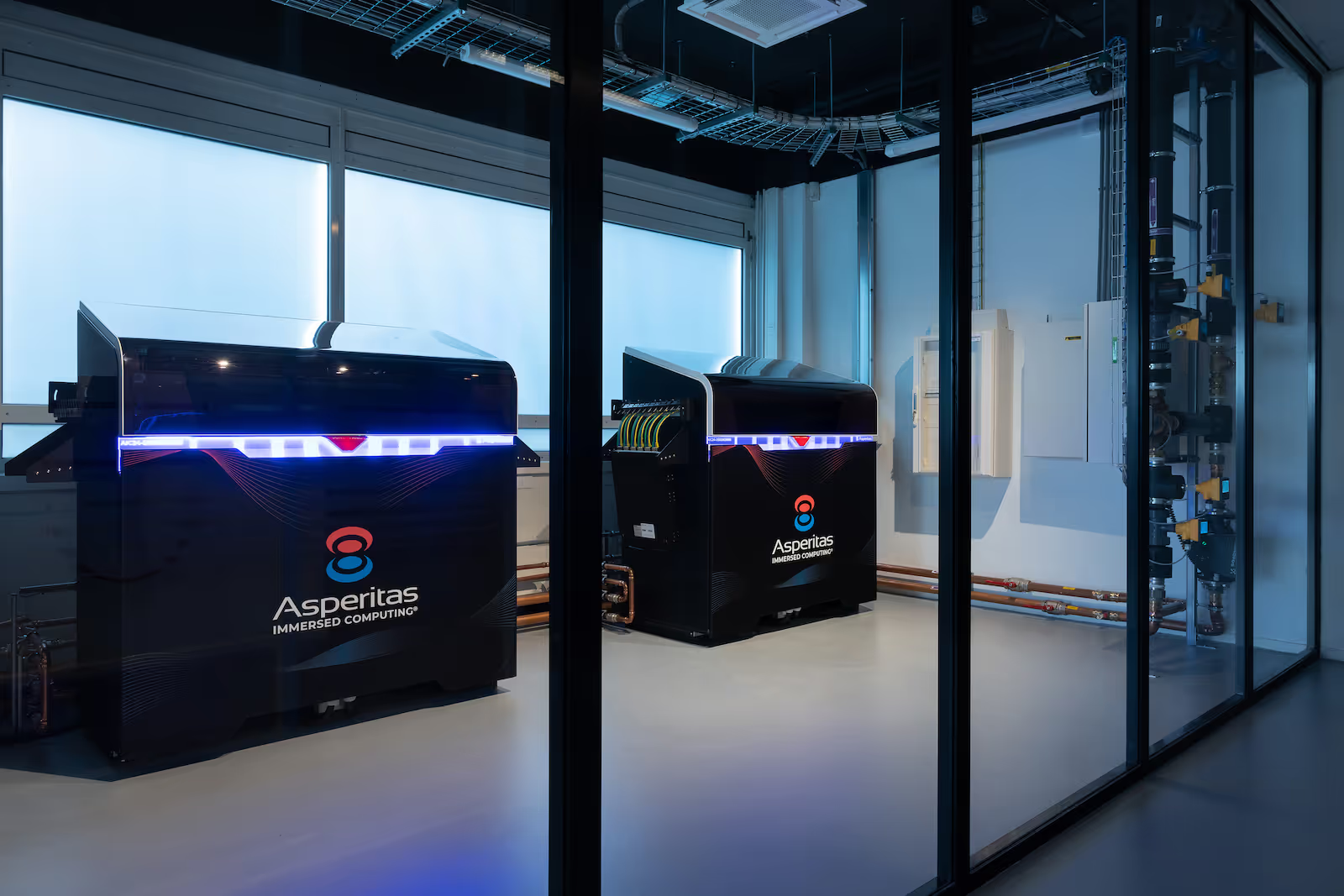
Immersion cooling enables a plug-and-play model for compute deployment. By creating a self-contained, liquid-stabilised thermal environment, immersion systems remove many traditional dependencies.
In effect, the system becomes a datacentre-in-a-box, where:
• Servers are cooled locally inside the system
• Airflow management is eliminated
• Precision HVAC is no longer required
• Ambient conditions become far less critical
For edge and on-premise deployments, this simplicity is often the decisive factor.
Why Immersion Cooling for IT Integrators and Service Providers
IT integrators and service providers design, integrate, and often operate compute platforms for multiple customers and workloads. As hardware diversity increases, cooling complexity can become a limiting factor.
Immersion cooling offers integrators:
• Predictable integration environments
• Flexibility across hardware generations and architectures
• Higher density without facility redesign
• Simpler, more stable operations
• Repeatable deployment models
• Differentiation in a competitive market
• Higher IT utilisation on optimal performance levels
For many integrators, immersion cooling becomes a platform choice, not a one-off project decision.
Try limitless cooling performance today. Get in touch.
What This Looks Like in Practice
Immersion cooling is ultimately an architectural decision. Its value becomes clearest when viewed through the concrete challenges operators, integrators, and service providers face today.
Example 1: Upgrading an Existing Datacentre for Higher-Density (internal) Customers
You operate an owned datacentre or a colocation facility and are seeing growing demand from customers deploying GPU-accelerated, AI, or otherwise high-density workloads. Electrical power is available, but cooling capacity, airflow constraints, and water usage are becoming the limiting factors.
With immersion cooling, you can:
• introduce dedicated high-density zones without re-engineering the entire facility
• decouple customer density requirements from aisle containment and airflow design
• reduce reliance on chillers, cooling towers, and evaporative systems
• stabilise PUE across seasons rather than chasing incremental improvements
• accommodate customers with very different hardware profiles on the same site
In practice, immersion cooling allows you to unlock additional IT capacity inside the existing mechanical and spatial envelope, extending the life and commercial relevance of the building.
Example 2: Building an HPC or AI Cloud Service
You are designing an HPC or AI cloud platform where performance consistency, density, and operational efficiency directly influence competitiveness. Hardware power envelopes are rising, and accelerator architectures are evolving rapidly.
Immersion cooling enables you to:
• deploy high-TDP CPUs, GPUs, and accelerators without airflow or acoustic constraints
• redesign server layouts around compute density and interconnect efficiency
• eliminate server fan power and reduce thermal throttling under sustained load
• support mixed hardware generations within the same cooling architecture
• standardise clusters for repeatable deployment and predictable scaling
Here, immersion cooling becomes a strategic enabler rather than a tactical optimisation.
Example 3: Redesigning the Hardware Stack as an IT Integrator or Service Provider
You design, build, and operate clusters for your own platforms or on behalf of customers. Hardware roadmaps are diverse, and thermal requirements vary widely.
Immersion cooling allows you to:
• decouple server and board design from airflow assumptions
• qualify a broader range of components on a single cooling platform
• support heterogeneous workloads without reworking cooling per configuration
• simplify system integration, validation, and long-term support
• create differentiated service offerings based on density, performance, or sustainability
Cooling shifts from a constraint to a design variable.
Example 4: Deploying Compute Outside a Traditional Datacentre
You need to deploy compute on-premise, at the edge, or in industrial or telecom environments where precision cooling infrastructure is limited.
Immersion cooling enables you to:
• deploy compact, self-contained systems with their own thermal environment
• operate reliably in dusty, hot, humid, or variable conditions
• avoid raised floors, ducting, and tightly controlled air handling
• reduce dependency on local operational expertise
• roll out modular systems consistently across sites
Here, immersion cooling is about making high-performance compute deployable where it otherwise would not be feasible.
Example 5: Deploying Standardised Zones Across Multiple Climate Regions
You operate compute infrastructure across multiple geographies but want a consistent operational model and service level.
With air cooling, climate variability drives complexity. Immersion cooling localises thermal management inside the system, allowing you to:
• deploy the same architecture across hot, cold, and mixed climates
• minimise climate-driven variation in efficiency metrics
• maintain consistent thermal behaviour and performance
• standardise monitoring, controls, and operational procedures
This supports repeatable global zones that behave predictably regardless of location.
Example 6: A Large Enterprise with ESG and Regulatory Responsibilities
You operate IT infrastructure under formal ESG commitments and increasing regulatory scrutiny. Energy, water, and carbon metrics are tracked and audited.
Immersion cooling supports these objectives by:
• lowering overall energy consumption
• eliminating server fan power
• reducing or eliminating water usage
• enabling higher-grade heat suitable for reuse
• providing stable, predictable metrics for reporting
Here, immersion cooling is adopted as a long-term architectural decision aligned with corporate accountability.
The Common Thread
Across all scenarios, immersion coolingprovides architectural optionality.
It enables organisations to deploy morecompute within existing constraints, adapt to evolving hardware, standardiseoperations across environments, and reduce exposure to energy, water, andinfrastructure volatility.
In that sense, immersion cooling is notjust a cooling technology—it is an enabler for what comes next.
Next steps, how to get started with immersion cooling
It all starts with planning and road mapping. Setting sustainability objectives is one thing, but it’s important to also identify your performance requirements for the next few years. Also ask yourself, where do you see your workloads being facilitated? The next step is to share the project brief with us. Then it's a matter of gaining experience via remote testing and on-site experiences, starting with piloting and then building your scale-out plan.
Ready to get started?
Book your free consultation now. Let us guide you to a more sustainable and efficient datacentre.